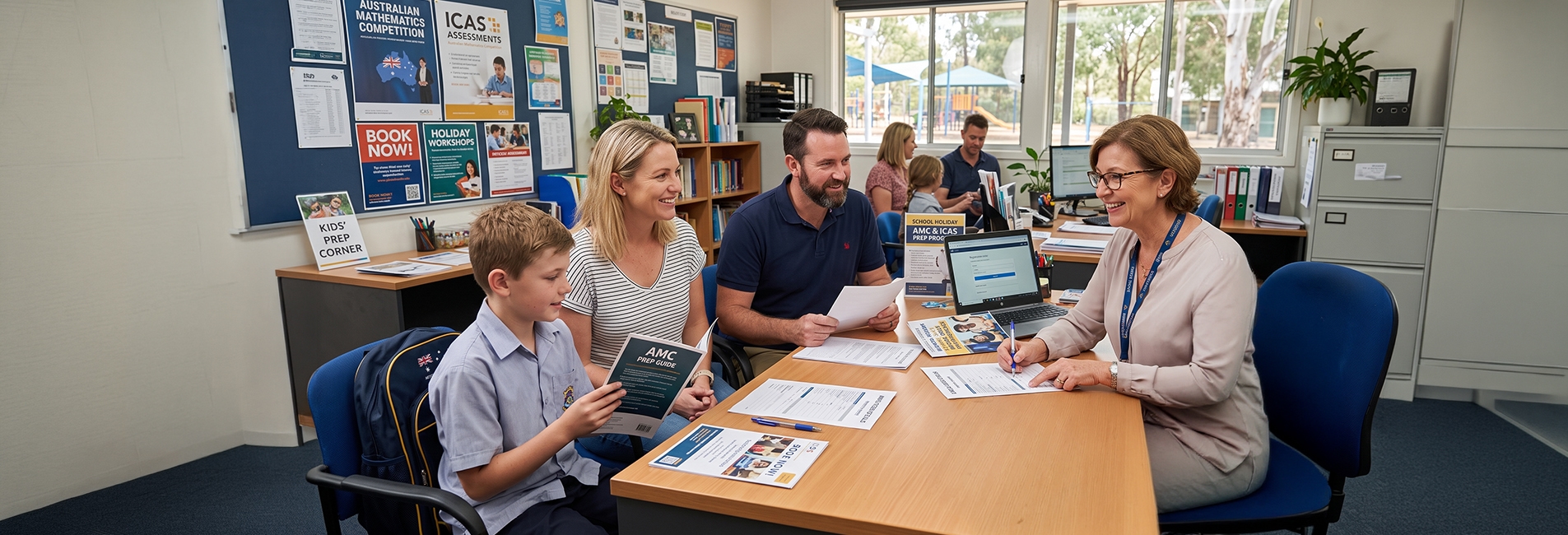
Every year, parents across Point Cook, Melton and Melbourne’s west ask us some version of the same question: should my child sit at AMC? Do we need ICAS too? Are we already behind on selective school preparation? It’s a fair question. AMC preparation, ICAS preparation and selective school preparation often get lumped together as one big exam season, when they are actually three quite different challenges.
💡 Each exam tests a different kind of thinking. AMC rewards mathematical problem-solving, ICAS rewards subject depth, and selective school entry rewards reasoning under time pressure. Preparation that works for one can fall flat for another.
Understanding these differences early saves families months of unfocused study, and it protects something far more important than a certificate: a child’s confidence. In this guide, we’ll walk through what each exam actually assesses and the mistakes we see parents make most often. Then we’ll show how to build a study plan that builds confidence instead of burnout.
Three Exams, Three Different Skills
🧮 AMC
- Tests mathematical problem-solving, not just speed or memorised formulas
- Available to students in Years 3 to 12.
- Run once a year by the Australian Mathematics Trust, which has organised the competition since 1978
- No penalty for a wrong answer, so a sensible attempt is always worth making
📚 ICAS
- ICAS covers six subjects: English, Maths, Science, Digital Technologies, Writing, and Spelling Bee.
- Measures how deeply a student understands a subject, beyond their year level
- Open to kids in Years 2 to 12
- Each family picks one or two subjects instead of taking all of them
🏫 Selective School
- Assesses higher-order thinking, problem-solving, reasoning, comprehension and interpretation, all under strict time limits
- Students sit the test in Year 8, with successful applicants starting Year 9 the following year.
- Victoria’s four selective entry high schools — Melbourne High School, MacRobertson Girls’ High School, Nossal High School and Suzanne Cory High School — offer a limited number of Year 9 places between them each year
None of these exams require a child to be “gifted”. They reward students who have been taught to think things through calmly, and that’s a skill any student can build with the right guidance.
What Parents Often Get Wrong
Before looking at each exam individually, it’s worth clearing up a few assumptions that quietly get in the way of good preparation.
- "More practice papers always mean a better result"
- "A child good at maths will find all three exams easy"
- "We should prepare for everything at once, just to be safe"
- "A lower score means this pathway isn't right for my child"
- Understanding a concept properly beats repeating the same question type
- Each exam rewards a different mix of skills
- A staged plan, one pathway at a time, prevents burnout
- Most students improve significantly with clear, guided practice
AMC Preparation: Curiosity Beats Cramming
Good AMC preparation is less about memorising formulas and more about building the confidence to sit with an unfamiliar problem until a method appears. Students who enjoy the AMC tend to be the ones who are comfortable pausing on a hard question, rather than panicking at it.
The most useful way to prepare is steady exposure to a wide range of problem types well before the competition. Review should focus on the reasoning behind an answer, not just whether it was right or wrong.
Done well, this kind of maths competition coaching builds reasoning skills that last well beyond exam day, and many of them transfer directly into ICAS and selective school preparation too.
ICAS Preparation: Depth Over Breadth
ICAS preparation rewards genuine subject knowledge rather than broad, shallow revision. Because ICAS spans several subjects, families are usually better off choosing the one or two areas where their child already shows real strength or curiosity. Entering every subject on offer rarely pays off.
For families weighing up which subject to start with, a maths tutor, English tutor or science tutor who understands the ICAS format can help. They’ll identify where a child’s natural strengths already sit, and build from there.
📌 Extra worksheets alone rarely move the needle for ICAS. Structured sessions that build subject understanding alongside test technique tend to make the biggest difference.
Selective School Preparation: Racing the Clock
Entry into Victoria’s selective entry high schools is highly competitive, and the format of the test is a skill in its own right. The exam assesses reasoning, problem-solving and comprehension under tight time limits, so students need to be genuinely comfortable with pacing, not just the underlying content.
Good selective school preparation builds the reading, reasoning and writing skills the test demands. It also gets students used to the timing and structure of the exam long before the actual day. For families starting earlier, consistent primary school tutoring and NAPLAN tutoring in the years beforehand often lay the groundwork that later selective entry exam preparation builds on. Many of the reasoning skills used in scholarship exam preparation for private schools carry over neatly into selective entry exam preparation as well.
Book a free assessment, and we’ll help you map the right preparation plan for AMC, ICAS or selective school entry.
Choosing the Right Pathway for Your Child
The families who navigate these exams most successfully aren’t doing more work. They’re simply starting earlier and preparing more deliberately.
Start With Genuine Interest, Not Just Ability
A child who enjoys a subject will keep going long after one who is only sitting an exam because a parent wants them to.
Build Understanding Before Timed Practice
Timed papers only help once the underlying concepts are solid. Practice before understanding just rehearses confusion.
Protect One Rest Day a Week
Steady, well-rested preparation over several months beats an exhausting sprint in the final few weeks.
Track Progress, Not Just Scores
A tutor or parent who can see where a student is genuinely improving keeps preparation focused on what still needs work.
A Realistic Year of Preparation
Here’s roughly how a well-paced preparation year looks for a family juggling one or more of these exams, without any last-minute cramming.
Assess and Choose the Right Pathway
Identify genuine strengths and interests first, then decide which exam is actually worth prioritising this year.
Build Foundations, Not Just Practice
Concept-first sessions close gaps and build the reasoning skills that every one of these exams draws on.
Introduce Timed, Exam-Style Practice
Once concepts feel solid, timed papers build pacing, stamina and familiarity with the exam's real format.
Fine-Tune, Rest, and Walk in Confident
The final review focuses on confidence and calm, not last-minute cramming. Rest is part of the plan, not a reward for finishing it.
The BrightMindz Approach: Teaching Kids to Think, Not Just Answer
Concept-First Teaching
Builds transferable reasoning skills that work across AMC, ICAS and selective school formats alike.
Concept-First Teaching
Clear, specific updates so families always know what’s improving, and what still needs attention.
Conclusion
AMC, ICAS and selective school entry are each valuable in their own way, but they are not interchangeable. Preparing for all three at once, without a plan, is where students burn out. Families who navigate this well start early, choose pathways that genuinely suit their child, and build understanding before adding pressure.
Whatever combination is right for your family, the goal stays the same: a child who walks into the exam room prepared, calm, and genuinely confident in their own thinking. If you’re weighing up AMC preparation, ICAS preparation or selective school preparation for a child in Point Cook, Melton or across Melbourne’s west, the team at BrightMindz can help you map a plan that fits.